The Winds Of Winter: Chinese Structural Reforms

Since the great financial crisis, the best and most dangerous lesson, rational investors like myself have been forced to learn is to never underestimate the devastating combination of central government power and public aversion towards painful outcomes.

When the US market turned down in 2011, the Fed responded with QE2. When the European Sovereign debt crisis came to a head in 2012, Draghi did whatever it takes. When Japan suffered a massive earthquake and ran its first trade deficit, Abe and Kuroda responded with QQE and Abenomics.

Governments and central banks around the world have prevented market forces from correcting artificial trends. The longer this goes, the more accepting market participants are of these outrageous and extraordinary actions. When looking at each event with virgin eyes, one gets a much better picture of the dire situation the world finds itself in today.

Perhaps there is no place in a more precarious position right now than China, whose 35 year credit fueled bubble is coming to an end. A long time ago, China decided to peg its currency to the dollar. At the time it was smart, because the US was exporting lots of debt and devaluing the dollar for almost thirty years. By pegging the Yuan, to the dollar, China could soak up US debt and at the same time enjoy a depreciating currency that benefitted it’s exports driven economy.

But now the Chinese are discovering the double edged nature of the Yuan’s peg to the dollar. With the dollar strengthening against the Yuan for the first time in decades, capital is fleeing China in record amounts and the wonderful FX war chest, China has built up over the decades is draining faster than Saudi Arabia’s. To make matters worse, the PBoC has been forced to engage in one of the worst trades in history. They are selling US treasuries which are rallying, and using the dollars they get to buy a depreciating currency, the Yuan, with which they use to buy falling equities, the Chinese stock market. On every aspect of that trade, the PBoC is coming out a loser. Yes it buys them time, but as we’ve seen, it’s not enough, and it appears that the PBoC and the CCP have both realized this.

And now for the first time, in a LOOOOOONG time, we are hearing government officials discuss the dreaded “Structural Reforms“. And it’s not some developed western nation but members of the Chinese Communist party. It seems, at long last that the Chinese both plebeian and party member alike can see that the current systems is not working. This turning point, in the Chinese narrative cannot be understated.

A quick excerpt reads:

Q: What are the major tasks of supply side structural reform?

A: The five major tasks include reducing production capacity, unloading inventory, de-leveraging, lowering cost and filling the short board of the economy.

Deleveraging is the path to a recession. Deleveraging leads to debt writedowns, which leads to losses, which leads to hate which leads to rebellion which leads to the dark side! Star Wars references aside, the fact that China’s leaders are willing to discuss structural reforms as an important part of China’s near future should be very scary for the already beaten up financial markets, because baby they ain’t seen nothing yet. A few percentage points off the Yuan don’t make much of an impact. But another 10-15% or even greater decline, now that will have some serious impact. And let’s not forget the drop in global demand that would follow any Chinese write-downs or structural changes.

The fact remains that China hasn’t even begun to deal with its structural reforms and the global financial markets are already reeling. Now that China has publicly committed to structural reforms, it’s only a matter of time before the real pain starts. The main trades here are deflationary and risk off related. US treasuries and dollars are screaming BUY. Tech stocks, emerging market equities and high yield or low grade corporate debt are just among the many things screaming SELL. 2016 is quickly shaping up to be a year with more landmines than firm ground. Be careful where you step.


Market Comments – 1/7/2016 – Panic and Blood

Dear Markets and Investors,

That metallic taste on the tip of your tongue, that’s blood. The rapidly beating object in your chest, that’s your heart. The tingling sensation in your extremities, that’s panic. Panic, fear, blood, what a start to the new year. What I find most interesting about these events, is the real fear in the markets. For the first time, in a long time, the markets are scared. And they should be. The Fed no longer has their backs.

But that doesn’t mean, China for the short term, isn’t contained. To think that China can’t handle this, is foolish. Does this speak to a much larger internal problem that China is dealing with? You betcha. But they still have $3.3trillion in FX reserves. And they’d rather open that door again then open the mystery door and find out what’s behind it.

So what I’m saying is that the market reaction, although justified, will die down, and the Fed will come in with some very supportive language to help ease the markets. In the end, I expect a small rebound over the course of the next week or so. Look at this event as a wakeup call to get even more defensive.

Regards,
The Klendathu Capitalist

There And Back Again: A Yield Curve’s Tale

In the latter half of 2014 and all of 2015 I was a firm believer that US interest rates would either fall or not rise significantly, which I thought made for a safe investment opportunity with limited downside. However, a lot has changed over the course of 2015. The strengthened dollar has put pressure on commodities and EM economies. Cracks big enough to draw media attention are forming in the US economy and with the Fed embarking on its first rate hike cycle in 11 years, I think it’s a good time to reassess my position.

The dollar sharply rose through the first half of 2014 and before peaking in March of 2015. Expectations for lift off were as early as April, but the Fed successfully pushed the date back another eight months, and with it, the dollar stalled. But now the Fed is finally hiking interest rates. And if the dollar strengthens from here, an already high plateau, the knock on effects for the rest of the world will be quite noticeable.

The dollar will most likely rise in 2016, and the Fed hiking interest rates is just one reason why. History shows that in a currency war, the country who eases wins. And right now the Fed isn’t easing. It’s tightening, which is going to slow down the economy as exports become less competitive and the debt burden becomes too great.

And of course the US still has to deal with the shale fiasco. Remember, not many US shale companies have gone bankrupt yet. Production has only fallen about half a million bpd. The US added on close to 5 million bpd during the shale boom. This time bomb hasn’t detonated and yet low oil prices are hollowing out some sectors of the American economy.

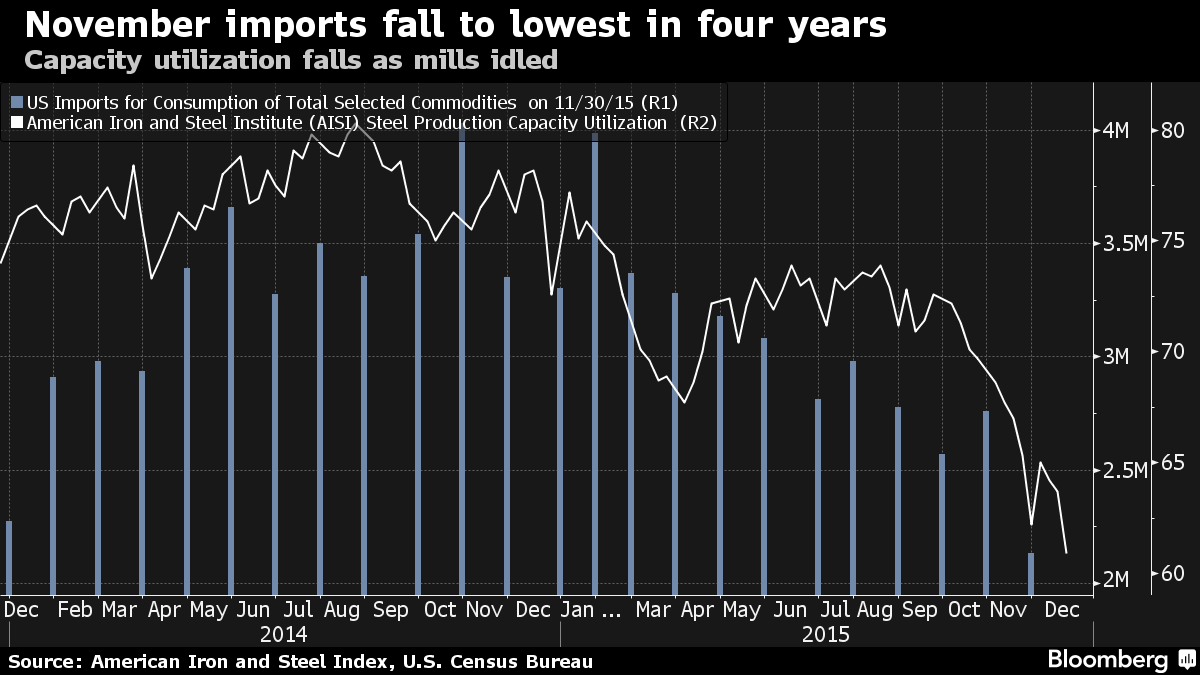
US steel production capacity has dropped from a high of 80% in 2014 down to just above 60% in December. To make matters worse, it’s actually still falling with no rebound in sight. Steel imports are also down for the year. Remember, when the Fed told us back in January how falling oil prices was not only “transitory” but also a net benefit for the economy. I’m so glad these guys are some of the most powerful people in the global economy.

The US economy is slowing down just as the Fed is hiking rates. As demand falls, the US will send less dollars abroad which makes dollars in the foreign markets even more scarce, thereby making it harder for foreign nations to get their hands on them. Once again, taking the Fed’s rate hike as another drain on dollar liquidity, the outlook for dollar liquidity does not look good. But there is hope. President Obama can increase the size of government like it’s nobody’s business. Surely he will step up to the plate and spend a poop ton of extra money to keep the flow of dollars to the global economy going strong. Yeah he’s got that… Like totally…

Oh… Oh Darn. President Obama is set to run the lowest deficit of his tenure. At time when the world needs all the dollar funding it can get, the US government and the Fed are essentially telling the rest of the world to get the turkey out of the fridge.

There’s going to be a huge deceleration in global dollar liquidity, which could directly lead to a bit of a run on the dollar. As the dollar becomes more scarce and more valuable, demand for the green paper will rise. Thus the dollar will strengthen in 2016. Some of the implications for such a move will show up in my next post on the US treasury market.

When people look at back and wonder when the Fed should have hiked, even though I don’t think there ever would have been a “good” time, but there was certainly a better time. The response will be: would you rather hike interest rates when global dollar liquidity is rising at an accelerating rate or when it’s falling?

To its credit, the Fed has set up standing swap lines with five central banks: Canada, Switzerland, England, Japan, and the ECB. Which means that during times of a lack of dollar liquidity, the Fed can swap trillions of dollars for trillions of yen or euros etc and these nations will have the necessary dollars to prevent a systemic collapse. However, you will notice that the Fed has no such lines with any Asian countries, in particularly China. I’m not saying we are headed straight for a currency crisis. I’m merely pointing out that demand for dollars is outstripping supply in the global economy, which is very bullish for the dollar.

Now China lies at the very heart of collapsing commodity bubble. Its economy has slowed greatly as overcapacity, malinvestment and a high debt load weighs on the country’s ability to transition from exporter to consumer. As the dollar strengthens so to does the Yuan, which hurts China’s exports because its trade partners are all devaluing their currencies against the dollar and the yuan.

Canada, Australia, and New Zealand have all cut interest rates in 2015. Since the dollar bull rally began in mid 2014, the three currencies are down 23% against the Yuan, and that’s including the Yuan’s recent devaluations. This currency mismatch is forcing China’s economy to transition too quickly away from its exports. Thus the PBoC will devalue the Yuan, to stabilize exports, while not losing too much purchasing power in the process since China produces a large percentage of its own goods and services. However, such a devaluation could have a tremendous impact on dollar liquidity in Chinese markets.

For over a decade, the Yuan was a one way bet against the dollar. The idea, borrowing lots of dollars, and paying back with cheaper dollars was very enticing to Chinese companies. That is until, the party ended in late 2013 . Ever since, the dollar has been on rising in jumps and fits against the Yuan, and the PBoC have been holding on for dear life. With the dollar set to head higher in 2016, we now find that a lot of Chinese companies are on the wrong side of the boat, waiting for a wave of devaluations to capsize them.

In the long run, the devaluations are massively deflationary for the rest of the world as they seek to export their own deflation which would bring down US bond yields. However, in the short run, until the PBoC widens the trading band, they will be forced to sell treasuries in order to defend the Yuan.

Like the Yuan other currencies pegged to the dollar could be in jeopardy.  Saudi Arabia receives most of its dollars from selling oil. The price oil has forced Saudi Arabia’s hand. In order to maintain the peg, without enough oil dollars, Saudi Arabia must sell its dollar denominated assets such as treasuries and or equities. I discussed in my previous post why a Saudi unpegging is unlikely, and therefore expect this pressure to be for the long term or until oil prices rebound substantially.

Now the Fed owns $2.5 trillion in treasuries but they ain’t selling. Not for a looooooooong time. And just like that $2.5 trillion, in mostly long term bonds are taken off the market. Which means liquidity in the treasury market falls, leading to bigger reactions to smaller moves. Thus countries dumping treasuries to defend their currencies, combined with a Federal reserve trying to force people into higher rates puts enormous upward pressure on US interest rates.

But in the end, the Fed’s recent actions may be misguided and misinformed. US growth both in the private and public sectors is slowing down. The dollar liquidity is shrinking in the rest of the world at a time when they need it most. Which brings me to the final chart.

Central banks that have tried hiking interest rates have all been forced to backtrack. Japan who isn’t even on this list, has hiked rates multiple times in the past 20+ years and we all know where their interest rates are. And given the Fed’s so ridiculous it would be funny if it weren’t so depressing track record I believe they will too be forced to lower interest rates by early 2017.

In the end, I think the treasury market is a tale of two time horizons. Short term there seems to be a lot of forces pushing rates upward in the US. Foreigners are selling treasuries. The Fed is raising rates. But long term, the dollar will rally, the chinese will devalue, the US will slow and the Fed will be forced to ease. A scary thought is we could see a multi decade high in the dollar on the back of record low interest rates. If that happens, I’ll probably sell both. That’s it for now.



The State Of Oil: Lower For Longer

Oil

As people are being forced to learn, central banks have made markets incredibly unstable. In few places is this more clear than the oil market. The artificial demand that their free money policies created, led to an equally artificial rise in oil prices. The high oil prices created an environment for higher priced oil projects to come online. Throw in artificially low interest rates which incentivized leverage and debt and you start to realize how a 20% drop in the price of oil can cause it to drop another 50%.

As of writing, the price of oil is trading in the mid 30’s. I remember back when oil crashed to $55. The market and its participants reaction were in pure and utter disbelief. The little caveman in their heads told them this move was unnatural, and it was, just not for the reasons they thought. After all, a major commodity such as oil shouldn’t drop 50% in six months…

But it did, so everyone and their aunt was trying to pick the bottom.  Oil traders bought oil and stored it on ships out in the ocean, or piled up crude on shore in the hope that the price would rebound. But that never happened. It’s been 16 months now since oil peaked in 2014, and most anyone who bought oil to sell at a future date has lost considerable amounts of money. As time goes on, storage costs increase as storage space declines. In short, the traders created an artificial front load in demand, and an artificial backload in supply. At some point this oil will have to come back to market, and with double the number of oil tankers waiting at sea from the beginning of the year, it will have considerable downward pressure on the price.

It’s not just oil traders that have been storing vast quantities of oil. Countries around the world are filling up their tanks to the brim. The US crude storage is at a record high 490 million barrels. According to OPEC, crude oil stockpiles in OECD countries currently exceed the running five-year average by 210 million barrels. To put it mildly, the world is pumping out more oil than is being consumed. The price will continue to fall until this trend is reversed.

It is pretty obvious that, this is a supply side issue. Demand didn’t fall off over night. No, supply has been steadily increasing. Especially since the price of oil started to fall, countries and companies have been forced to pump out even more oil to maintain revenues with even more production. Which is why we see in the face of decade low oil prices that production has increased. Russia, Saudi Arabia, and the United States have all reached multi decade highs in oil production in 2015.

1x-1

Perhaps one of the most interesting domino effects due to low oil prices is the surprising ingenuity of producers. Even if at unprofitable levels in the long term, in the short term if the well is tapped, and the oil is gushing, there’s no point in stopping. Break even prices for a tapped well are still much lower than the current $36 dollar per barrel at the time of this article. But that’s not all. US shale companies have drastically been able to reduce costs. In the early days of the shale boom the break even price for shale was thought to be around $80, now the breakeven price is much lower, in the 50s or even lower. The point is that US Shale is dying a lot slower than certain invested parties thought.

But it’s not just the Americans that are thriving under the pressure of low oil prices. Armed with new technology, Russian companies are effectively finding and extracting oil from old Soviet wells. As a matter of fact, in 2015,  Russia recorded its highest oil production since the fall of the Soviet Union. Another boon to Russian oil, is the fall in the ruble’s price against the dollar. Since most of Russia’s oil operations are priced in rubles, Russia’s cost of extraction has fallen tremendously over the past few years.

Saudi Arabia doesn’t have the fortune of a weak currency that Russia does. And there’s a good reason for that. Saudi Arabia is a desert kingdom. Nothing grows there. There’s no mining sector. There’s no agriculture. They used to grow vast quantities of wheat at a very high cost, but that has been slowly phased out. There’s nothing but oil sand and religion. They have a very young and undereducated population. The fact that the kingdom needs 6 million foreigners to pump their oil is not a good sign either.  The point is, that Saudi Arabia produces nothing but oil which it’s own citizens aren’t even capable of doing. Saudi Arabia’s life blood, is the wealth it receives for its oil and nothing else. Thus the country must important almost everything it needs to survive and or thrive.

If the currency falls, import prices rise, which is essentially the price of everything Saudi Arabia needs, the result of which is rising inflation. Faced with rising inflation, a weakening currency, falling revenues, and declining wealth, how do you think Saudi Arabia’s young, uneducated and highly religious population will respond? Which leads me to believe that the very last thing the Kingdom will do is unpeg the Riyal. I’m not saying it can’t happen, I still think it could, but if you look at the effects a currency devaluation will have on the Saudi Arabian social order, it doesn’t seem likely in the short term. Saudi Arabia would have to be in dire straights to be forced to unpeg it’s currency. And although it is headed in that direction, it would take a few years of significant FX reserve drain or a few very important factors that would have to occur that would make the peg unsustainable.

What are those factors? First and most importantly, is the forex reserves. This is their ammunition to defend the peg. As long as the reserves don’t dwindle too quickly, Saudi Arabia should be able to defend the peg. But as you can see the currency reserves have fallen off a cliff in 2015. After peaking at roughly $740B in 2014, forex reserves have fallen to $633B as of december 2015. The government posted a budget deficit of 15% for 2015. At this rate, with all things being equal, in 5 years, the country won’t have enough FX reserves to defend the peg. So we have our ticking, but must keep in mid, all things won’t be equal. Obviously the price of oil will change, but so too will the Saudi Government Budget. Steps have already been taken to reduce the deficit dramatically. The Saudi Government has reduced a wide range of subsidies for its citizens, as well as reigned in some spending. But not on weapons, because the Kingdom is busy fighting a few wars at the moment and needs to be prepared. With all that said and done, the Saudi Arabian government still projects it will run a deficit of 13% of GDP. Of course, this is under the assumption that the price of oil for 2016 will be $50.

Given the current market dynamics: increased production from Iran,  Iraq’s 25% increase in production over the course of 2015, record amounts of oil in storage, major countries producing record amounts of oil, the fed tightening monetary policy and US shale companies being unwilling or unable to shut off their wells at a fast enough to pace to make way for new and cheaper production, the price of oil looks to be headed in only one direction, down. That’s not to say we will see a spike or two back up to the 40s, but they will be temporary till more production comes off line.

1x-11

But the only place we could see a significant drop in production would be US shale. The EIA predicts that US production will lead to a paltry 500,000 bpd drop in production. This is not of significant magnitude to cause a rally in the price of oil. There’s just too much supply coming to market within the next year and not enough unsustainable production falling off. Despite a lot of the current supply being unsustainable in the long term, the short term should continue to get ugly. However, if oil drops into the 20s, which I believe short term is where its headed, then we could see a much larger drop in production from the US shale than the EIA is predicting. I doubt any US shale is sustainable in the 20s and we should see quite a few companies go the way of the dodo. Once again, it appears that the EIA like the Saudi Arabian Government is forecasting an optimistic oil price. Which leads me to believe that oil falling into the 20s could have enormous psychological effects on the market. Which could lead to extremely imbalanced positions in the currency markets.

To make matters EVEN WORSE, the Federal Reserve, in all its wisdom, has decided to raise interest rates!  At a time when the oil nations of the world are drowning in oil, here comes Janet Yellen stomping her steel toed boot on their heads! If the dollar strengthens, the price of oil in dollars will fall even further. But oil isn’t the only thing priced in dollars, so is the Riyal. After all it’s pegged to the dollar. And if it is to stay pegged, the Saudis will have to spend a lot more money to keep it that way!

The bottom line, is that oil is most likely headed even lower for the near term and will stay low for the remainder of the year. However, this goes against the forecasts of various governments and the markets. If I am right, the global economy will not be prepared for the dramatic events and knock on effects that even lower oil prices will have, whether that be excessive bankruptcies in US shale, falling inflation in across India, Japan, South Korea, China and Southeast Asia, or broken currency pegs. The point is, with these oil prices something will break, it’s a matter of time.


Fallout From The Fed’s Rate Hike Cycle

“I’ve never been more optimistic about a year ahead than I am right now. And in 2016, I’m going to leave it all out on the field.” ~President Barack Obama

I’ve tried coming up with a snarky sarcastic comment but I’ll let the quote speak for itself…

Just remember, this is a president who has never seen a rate hike let alone an actual interest rate. This is a president whose legacy has been built on the back of free money, and now that the Fed is hiking interest rates (for the first time in ten years), he’s never been more optimistic… Yeah… Um… Yeaaaah.

The most obvious consequence of a fed rate hike is a stronger dollar. As conditions tighten here in the US and dollars become harder to come by, increasing its value. When you take into account the amount of dollar denominated debt that foreign companies OWE, you start to see the possibilities of a very strong rally in the dollar.  A lot of these foreign companies do not operate in dollars so the only way for them to get more dollars is to go into the market and sell their currency in exchange for dollars. But when the Fed hikes it is essentially telling these companies that “the dollar is going to strengthen”. Thus it is in the best interest of these companies to buy dollars now before their value increases further. The result is a lot of dollar buying and emerging market currency selling.

If emerging market currencies continue to fall, then the central banks of these nations will be forced to intervene and prop up the currency by also tightening economic conditions. According to the WSJ,

The Bank of Mexico raised interest rates for the first time since 2008, despite record-low inflation and relatively slow economic growth, as the central bank seeks to avoid further pressure on the peso after a sharp depreciation this year.

Thus we can start to see how a Fed rate hike forces the entire global economy to tighten whether it is ready or not.

EM corp debt

Source: IMF


And let’s face it, EM corporations are not ready for a tightening cycle because they like their US counterparts have piled on debt in record fashion, more than doubling since 2008. Thus these corporations should do quite poorly during this tightening cycle as their debt burdens become unmanageable.

With their currencies and stock markets falling in tandem, we can expect a large flow of capital out of emerging markets and into developed markets, especially into the US. This flow will benefit US safe haven assets like treasuries but more importantly, I think that the flow of capital will eventually become so severe that countries will enact capital controls.

So let’s think, what asset does well in a scenario of falling currency, rising economic uncertainty and capital controls? The first and obvious answer is gold, but I’m looking past that at a smaller more volatile asset, Bitcoin. Bitcoin is a globally traded currency that ignores capital controls, which is why it so desired during times of crisis.

The fed rate hike cycle should spark an incredibly strong rally in Bitcoin. I would go as far to say that Bitcoin could be the best investment for the next few years. And because of its relatively small market cap, a small inflow can cause a big spike in value.

And there are many events that could cause a size able inflow into Bitcoin. For example, a strengthening dollar threatens a few very important currency pegs. Much like the ECB’s QE forced the Swiss National Bank to unpeg the franc from the Euro, I suspect Fed’s rate hike cycle will force the PBoC to reconsider the Yuan peg. Any significant devaluation in the Yuan will send millions of Chinese searching for a hedge against further devaluation and I believe one of the answers to their problem will be Bitcoin. Now this is just one such scenario but I find it even more likely than I did when I first mentioned it in a previous article.

But it’s not just the global economy that isn’t ready for a rate hike. Even the US economy isn’t ready for a tightening cycle right now and yet the Fed is raising rates. In the US we’ve already had our massive build up in credit. In an “ideal” world, the central bank is supposed to prevent this credit bubble, but the Fed was too late to tighten. After all their mandate said nothing about credit. They only cared about inflation and employment. A shame they didn’t realize how important a factor credit plays in both those indicators. Since inflation never reared its head, the Fed never considered hiking interest rates. Meanwhile, useless credit continued to pile up in the economy, flooding every asset known to man on a biblical scale.

So here we are with a too much credit, rising interest rates, and tightening credit conditions. Obviously this bodes quite poorly for US growth stocks, inflation, and heavily indebted corporations. I won’t go as far as saying US real estate is in danger, because Congress just repealed a thirty year old law that essentially prevented foreign pension funds from purchasing US real estate. With yield starved pension funds around the world looking for a place to jam their money, US real estate could be a tempting choice. I will say however, that all the conditions I listed above do bode well or at least not poorly for US treasuries. I expect the yield curve to flatten, as short term interest rates rise and long term interest rates to fall or stay the same. The resulting environment would be quite bearish for US banks who will surely try and raise lending rates to make any profit. Thus we could see a spike in mortgage rates even as 30 year treasuries decline. Something similar has occurred in Europe as a result of negative interest rates. The banks need to make more money than before since their cash stored at the central bank now carries a negative yield so they carry that cost on to their customers through higher mortgages rates. That’s all for now. I think my next post will be about the current oil glut and hopefully how to profit from it.


The Fed Hikes: The End Game Accelerates

05-janet-yellen-witch-w245-h368

Seven years into this “experiment”, I like a lot of other common sense inclined individuals found myself scratching my head at the FOMC’s decision to hike interest rates. After all, they’ve had seven years to cherry pick their moment and somehow we are led to believe that December 16th, 2015 was the best they could come up with? I don’t buy it. Given all the data: slowing economy, rising inventories, declining corporate profits, strengthening dollar, falling inflation, rising junk bond yields, I am hard pressed to find an actual economic reason to hike interest rates at this point in time. But let’s not get into the “why?”, because as important as that is, the “what the hell comes next?” is even more important.

I must admit I enjoyed watching Fed Chair Yellen try to explain their decision. I thought she performed admirably, at times I almost believed that she believed what she was saying was true and someone who knows nothing about economics or common sense might even be inclined to fall for her incantations.

But unlike Jon Snow, I know some things. Due to the Fed’s cheap money policy  credit growth exploded over the last few years. Rather than fueling investments and Capex, most of this credit growth went straight into stock buybacks and dividends. One of the few sectors where this cheap debt actually went into Capex was the OIL AND GAS sector, and we all know how well that’s doing, because the fall in oil prices is supposedly “transitory” according to Yellen.

EVERYTHING IS TRANSITORY! NOTHING LASTS FOREVER! SO TO CALL SOMETHING TRANSITORY IS FED SPEAK FOR I HAVE NO CLUE BUT I’M HOPING IT’S OVER SOON!

I’d be laughing if this wasn’t so serious, if the Fed’s miscalculations merely took place on a chalk board rather than a world with 7 billion people living on it.

Instead we find ourselves, on the verge of another catastrophic stock market explosion. Junk bond yields have spiked considerably in the last few months, which will make it harder for companies to service and acquire more debt. Once debt growth slows credit bubbles burst. So what was first attributed to the fall in oil prices causing debt bloated oil and gas companies to cry for help, has now spread to other sectors including the investment grade bonds. To make matters worse, inventories are on the rise in the US and profits are declining for the first time since the crisis. Like I said in the opening, the Fed could not have picked a worse time to hike except for perhaps tomorrow.

Let’s not forget that while the US may be the center of the world’s economy at the moment, it’s not the only one that matters. Emerging market nations OWE roughly $5 trillion in USD denominated debt. This means these companies, which do not have direct access to dollars, are going to have an even harder time paying back their debts as the Fed is now actively strengthening the dollar. The rush on the dollar will be enormous unless the Fed back tracks but it is probably already too late.

I don’t know the timescale for the collapse in the global economy but rest assured with the Fed hiking rates it has been accelerated substantially. We have now entered the end game and it’s time to get defensive.


Investment Tips:

If you read my articles for the past few years, I’m going to sound like a broken record here. But with the Fed hiking interest rates, the deflationary phase that my calls have been based around will only become stronger.

So if you listened to me over a year ago back in August 2014, you wouldn’t even be in the US equity market. The Dow is up only 5% since I made that call. It’s safe to say that I’m still not touching the long side of the US equity market with a barge pole, nor any equity market around the world for that matter. I still like long term US bonds, as inflation slows and the dollar rallies these should look like extremely attractive investments to other investors as well.

Another point of emphasis, is long/short currency positions. I’ve already mentioned the strengthening dollar but you still have to hold it against something. I prefer emerging market currencies that also are heavy commodity exporters. Saudi Arabia certainly falls under this category. As the Riyal is pegged to the dollar there is no risk of the trade going against you. It’s one way! Just sit back and wait for the fireworks, literally! Saudi Arabia is fighting a proxy war in Iraq/Syria as well as Yemen. It’s bleeding money as it struggles to defend its fellow Sunnis as well as its currency peg.

I’ve also talked a lot about China in the past, and we’ve seen the Yuan which is also pegged to the dollar weaken, but there’s still a long long way to fall. A 20% decline in the currency would certainly be a start. Then there are developed economies that are heavy exporters with divergent monetary policy that also look attractive for long dollar short their currency plays. Australia and Canada look particularly attractive. Both nations have housing bubbles high debt levels, large commodity exporters, high dependencies on Chinese consumption and are loosening monetary policy.

Profiting From China’s Collapse: Short Australian Banks

Over the past thirty years China has performed a herculean task of transitioning its country of 1 billion people from an agrarian economy to an industrial economy. The world has gone so far as to label this transition a “miracle”, because no one has ever seen such a thing in his or her life time. This isn’t even a once in a generation or life time transition, this is never seen before in history. Let that sink in a bit because it can be difficult to fully grasp the scale of what China has accomplished over these past 30+ years. Probably the most amazing thing about this transition is that China hasn’t even paid for it. That’s right, the most magnificent economic transition in recorded history has not been paid for… yet.

Instead of paying down its debts, China has continued to build and build  both its debt and its infrastructure. In just over a decade, China has QUINTUPLED (5x) its banking assets to a ridiculous $26 trillion or twice as large as US banking assets. As China continues to crash the whole world will feel its wrath. But not all countries will feel the effects equally or at the same time. As timing is everything it is very important to short the countries that will be hurt from China’s fall first and then use the profits from those plays to short the other nations as the domino effect plays itself out.

Countries first affected by China’s collapse will be the ones that have benefited the most from its rise. These are resource heavy economies such as Brazil, Australia and Canada. These countries have been pumping out resources and increasing capacity to meet China’s ever growing demand. But as China has slowed down, the world has seen a supply glut of resources and no demand to meet it. As a result the commodity super cycle which peaked in 2012 is starting to crush these heavy exporting nations. Brazil which has just recently entered a recession has been the first to fall, but there exists other nations close behind that have still managed to stay afloat. But in my mind these countries, their banks their corporations and their currencies are starting to feel the drag of China and will very soon join Brazil.

I’ve mentioned Australia before, and I’ll mention it again because I think it is at the top of the list of countries that will take a hit as China crashes. Australia’s largest export partner is China. It has the 2nd highest household debt in the world. It has a property bubble and it too has suffered from terrible government guidance. So not only is Australia dependent on China, it too is extremely over levered!

To show you how royally screwed Australia is, this is a chart from 2012. Here we see the ridiculous projections the government made.  They predicted Iron Ore to rise 50% in the years following 2012. Instead Iron Ore, as I PREDICTED back in 2013, in my very first post, plummeted. It’s current value at $52/Mt is only 8% of what the Australian Government predicted it would be. Let’s give another round of applause to government forecasters, for with their logic all things are truly possible! On the back of those predictions, Australian mining companies greatly weakened their positions as they acquired useless capacity for artificial demand. As china crumbles under the weight of its massive debt build up, Australian mining companies will be left in the dust to reap the impending whirlwind.

Back to the Australian banks which have offered some the largest dividends in the developed world. This has attracted lots of capital and increased their share price. But the flip side is that the people who invested in these banks, only put money in them because of the returns they’d be getting on their equity. Now the share prices are falling, these investors will start to get a little weak in the knees and head for the exit. But the share price hasn’t fallen that much, as Australian banks on a Price to Book value are more than 150% over valued compared to their American counterparts! You add all this up and Australian banks look to be a great one sided bet!

The Yuan Devaluation: Resistance Is Futile

China’s artificial peg is starting to crush its own economy. For a long time China has lived by the sword of its undervalued currency. But now things have changed. The foundations on which it was built rising commodity prices, falling dollar, a growing global economy are all are crumbling.

As I noted back in JANUARY of this year, the Yuan’s artificial peg would create a feed back loop between China and its trade partners. It goes like this: As china slows down, its trade partners like Australia and Canada will also suffer a slowdown. As a result Australia and Canada’s currencies will fall but the Yuan won’t because it’s pegged to the rising dollar. So the disparity between China’s currency and that of its trading partners will continue to grow decreasing demand for Chinese goods which will in turn only worsen China’s economic situation.

To make matters worse, the Fed is threatening the first rate hike in over nine years. Which is what I believe led China to start the process of devaluation. Technically the Chinese haven’t devalued, they are merely lowering the level of support they’ve previously given to the Yuan. And yet, they’ve still managed to burn through $100B in US treasuries in the past 2 weeks alone. There’s some irony here because the Chinese don’t want the Fed to hike rates but via their long term treasury liquidation the Chinese are forcing long term interest rates higher.

What is most interesting about this whole scenario is that the PBoC is doing everything in its power to defend the yuan’s peg to the dollar. Which begs the question why? Why waste important resources (FX reserves) defending what seems like an indefensible position? Why not just let the market take over? Well the obvious answer here is pain, not just for the average Chinese person whose wealth would evaporate in an instant but to the Chinese corporations that have borrowed over $1 trillion to finance their operations. That trillion isn’t in yuan, it’s in dollars, meaning the Chinese corporations have to pay back their debts in dollars which unfortunately is not the currency they operate in. Any significant devaluation would send most of these companies into default and the country into a recession. Obviously this is not something the Chinese government wants.

So for now the PBoC seems content with selling long term US treasuries to defend its peg. It is important to consider the knock on effects of such a strategy. The most obvious is in the short term, higher US interest rates, which for those holding long term treasuries will certainly make you a little queasy.  Higher long term interest rates will hurt the middle to lower end of the housing market since it will be harder for people to get mortgages. I’m not sure how much this matters as the high end market seems to be what really matters. Especially as foreign money continues to funnel in the US. But with the US economy growing at 3.7% in the 2nd quarter it seems like there’s a good chance (>50%) for the Fed to hike rates in mid September.

Will it happen? The Fed has a history of being gun shy and three weeks is a long time for things to go wrong, especially in this environment. If the Fed is insistent on hiking rates, the global equity and bond markets which are already on a knife’s edge will suffer in the run up. I’ve already stated that if the Fed does hike, the world will quickly fall into a recession. So let’s assume they don’t hike which is what a lot of people are assuming (praying). Will it be enough to out shine the shadow of a Chinese collapse? Short answer is no, but I think there will be a strong but short lived rally due to the intense anxiety market participants have over the upcoming decision. That’s it for now.

The End Is Nigh: China Syndrome

It only took 2 seconds to find this image on google. Pretty great huh?

Ever since the great financial crisis of 08/09 every country has been doing what ever it can to keep its head above water. But in their feeble attempts to prevent the inevitable, the major countries have linked their economies like never before. Where we find ourselves now is in a game of chicken where no one wants to go first and bring down everyone else. That was until China’s stock market in rather epic fashion decides to crash and as of writing this is now negative for the year (after being up 60% ytd). The world is now in panic mode because despite the PBoC’s best efforts, Chinese equities are crashing.

Let’s take a step back. Before China’s stock market began it’s meteoric rise, the Chinese real estate bubble was starting to crack. But don’t worry everyone, China has a plan which some people actually believed they could pull off. After all the plan was so simple. China was just going to “shift” its economy from a heavy exporter to consumer based one instead. Yup that’s right folks, after decades of building factories and plants and buying every mineral and commodity under the sun at the cost of trillions of dollars in debt, China was just going to “shift” away from this problem like it was doing the FOOKIN’ electric slide.

In order to start this ridiculous shift and prevent the toppling of it’s real estate bubble the PBoC  started to ease monetary conditions. The cheap money released from these actions didn’t go back into the real estate sector thus continuing the bubble instead it went into the stock market. And for a while the PBoC didn’t seem to care that it was replacing one bubble with another. After all, consumers would have more money from higher stock price. This would allow the economy to more easily transition to a consumer based economy. Sounds like an amazing idea! Why didn’t the Americans think to do that back in 2001 when the tech bubble burst? Oh wait, we did, and the end result was given the name “The Great Financial Crisis”. What name will history label China’s newest debacle that drags the world into the second great depression? Perhaps the GREATEST Financial Crisis? Or How The Fook Did Humanity Get So Dumb Crisis? With logic that makes the tulip bubble participants look like Einsteins, I think the latter would be a good title indeed.

For we are truly off the edge of the map, as the Chinese look down  to find 2 unstoppable bursting bubbles and zero tools capable of stopping the carnage. “Oh crap!” doesn’t do their predicament justice. But their predicament is the rest of the world’s as well. Just like the American housing bubble derailed the world economy so too will China’s double bubble.

The reason why? Because the world’s major economies have never been as fragile as they’ve been in the post-WWII era, perhaps never in history. Remember China was expected to be the growth engine that powers the world. It was supposed to spark Emerging Market demand with it’s new silk road and ridiculously expensive projects like the Nicaraguan Canal which now seem to be a complete and utter pipe dream.

The Bloomberg Commodity Index (pictured above) hit a 21st century low this week. Commodities getting crushed is only the start of the problem as the nations who heavily traded with China were expecting a steady rise in demand but instead are finding that demand is falling and the value of their commodities is crashing. This is a very dangerous cocktail for not just the companies themselves but the banks which lent them money. This is only the tip of the iceberg as the banks that lent the money are not in any shape to take losses.  Any country that was a major trading partner with China, especially commodity producers, are about to take a massive hit, and if it just so happens that their banks are in terrible shape then China’s crash will become their crash. Two of the most obvious countries that come to mind are Australia and Canada who just so happen to have the most indebted households in the world.

Here comes the –WTF Do I Do With My Money Section

  1. Short Australian and Canadian Banks
  2. Short AUDUSD and CADUSD or the reverse go Long USDAUD and USDCAD
  3. Long USDSAR – As the commodity sector gets crushed oil producers with currency pegs look particularly tasty.
  4. Long Treasuries – Deflation is great for the dollar. Times of Crisis are even better. Crashing Commodities are even better for long term rates.
  5. Short the Yuan. The Yuan is significantly overvalued. In the next year or two a devaluation of 50% or more against the dollar is more likely than the percent of devaluation itself. One only needs to look back at the last Asian Financial crisis for such a precedent.

I’ll go into greater detail in upcoming posts on some of these. Until then, good luck and hold on tight. It’s time to get super defensive.

US Shale Companies: The Chink In America’s Armor

Over the past 5 years, US Shale Companies have borrowed billions of dollars in cheap debt, which they haven’t repaid all while the price of oil has gone from $115 down to $44 in 6 months. To make matters worse the price of oil has remained low for months now. This has forced US Shale Companies to slash capex ie. future production to make debt payments. The problem here is that horizontal shale wells have a much shorter life span than traditional wells. Most shale wells decline by over 80% in just 3 years. So meanwhile these companies are pumping out record amounts of oil to keep revenues up, what they are really pumping out is what’s left of their extremely limited supply of oil. To make matters worse they are dumping it a basement prices!  There’s no  way the majority of  these companies will ever  pay back their debts with cheaper oil and decreased supplies and higher interest rates.

It seems the banks are no longer interested in this toxic mix and have stopped lending money even as energy junk bond yields have spiked.  With a Fed rate hike imminent banks seem unwilling to lend. In the chart below, my guess that biggest spike in credit rejection ever is primarily from US Shale and gas companies asking for another loan.

The price of oil meanwhile remains depressed as oil production from abroad continues to increase. Saudi Arabia has added 700,000bpd since December 2014. On the demand side, China’s epic slow down continues in a snowball like fashion which should lead to a further slow down in demand. The price of oil should remain low for the next 6 months which should be more than sufficient to sink these Fed created monstrosities.