Oil Ramblings – Post Doha

oil_sad

For better or for worse the oil markets have captured the world’s attention. Multi-decade low oil prices have  a way of doing that. Everyone knew there was an imbalance that needed to work itself out, and although the market seems to believe the worst of the turbulence is behind us, I still believe there are future air pockets ahead.

Back in January, most people myself included believed Saudi Arabia’s main goal was to crush US shale, however, at the Doha Saudi Arabia showed its true colors. It seems there was general consensus among the oil ministers of OPEC, but Saudi Arabia stood out from the pack unwilling to compromise unless Iran froze.

Which to be honest, was a ridiculous proposition. Iran has the most spare capacity of all the OPEC nations and is only just ramping up production and with foreign investment set to pour into the country future production capacity is set to rise even further. Delaying all of that with a freeze makes zero sense, especially considering that oil revenues on a relative basis to Saudi Arabia are almost inconsequential.

Perhaps one of the more interesting surprises of the meeting was Prince Mohammed Bin Salman’s threat that Saudi Arabia could flood the oil market with 1,000,000 bpd of oil at essentially the press of the button.

This is a very credible threat. The Saudi Prince’s ability to efficiently make quick decisions with little resistance has drawn the attention and jealously of leaders around the world. I can only imagine how Xi is watching and thinking “if only I had that power”.

The Prince has very smartly changed the incentive structure in Saudi Arabia. Instead of subsidizing everything from water and food to electricity and oil which hides the real cost of these goods, the kingdom has decided to give the value of these subsidies directly to its citizens, who now know the actual market cost of these necessary goods.

The obvious result is less wasteful spending. Whatever oil the Saudi people don’t consume Aramco exports. On the margin this is increasing, further adding to Saudi oil exports. Throw in the expansion of the Shaybah oil field that will add 250,000 bpd, the young Prince’s threat is looking quite credible.

Whether or not Saudi hits its target of an additional 1,000,000 bpd is not the point. The point is, Saudi oil exports are increasing. As is Iranian production, if only they could get the ships necessary to export, we’d really see a huge drop. And with the rising oil price, US shale companies have been able to hedge their production at profitable levels.

mi-cp312_oilhed_9u_20160422184835

All of this points to another down move in the price of oil. How low do we go? I don’t know. Back in January I argued that Saudi should cut prices and increase production at all costs to kill off a sizable chunk of US shale once and for all. Unfortunately, that didn’t happen and you can see in the chart above, there’s been a significant increase in hedging. Although a lot of these companies still carry too much debt and the next down move will probably kill off a lot of weaker ones and finally put a big dent in the multinationals whose share prices have been quite resilient in the face of this record decline in oil prices.

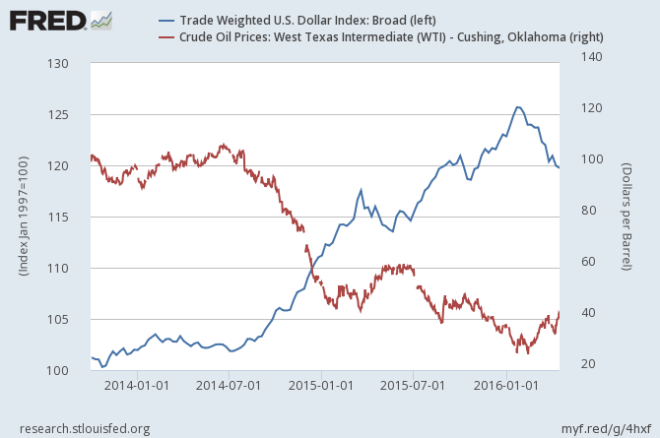
Unbeknownst to most investors, supply and demand mechanics aren’t the only thing driving the oil market. Of course, you guessed it, I’m talking about the dollar. Looking at the chart below, you see oil started to fall as the dollar started to rise. And then as the dollar peaked in January of this year, oil bottomed at $26.50.

fredgraph

I believe that the dollar’s rise is not over. Not by a long shot. We are in a consolidation period that will probably end by early July at the latest, if not much sooner. The mechanisms for this rise and their explanations are for another article. The point is, if the dollar resumes its uptrend, then oil will fall.

Lastly speculative positions in the oil futures market are coming off record levels. When you combine that with the fact that producers are actively increasing hedging, you see that the speculators in record numbers are on the wrong side of the boat.

20160415_salman3_0

With all that said, I think WTI over $45 makes for a very good short and would continue adding shorts on the whole way up to $50. Once again my time horizon is till early July for oil to start its down move. If it hasn’t happened by then, I would need to reassess my position. I don’t know how low it would go from here, and there are certainly a whole litany of variables that need to be taken into account, arguably most importantly is any central bank maneuvering such as Fed rate hikes or BoJ kamikaze money printing. But I think the trends, and positioning are on my side and will be watching closely to see how this all plays out.

Lithium: The Double Take

mv5bmtkzmzezodc2m15bml5banbnxkftztywmta5nty2-_v1_uy268_cr40182268_al_

This article is the equivalent of an investor double take. Much like the main characters in Michael Lewis’ book The Big Short who thought Greg Lipmann was trying to scam them, I too was skeptical about the potential of lithium and its future demand, but after writing this article I hope to solidify my position and convince others of that potential which exists in the future of lithium.

I’d like to preface the rest of this article by stating my affinity for RealVisionTV. I watch, at the very least, two videos a day. Every major China video I’ve watched at least three times, I’m currently on round 4 of Simon Ogus’ two part China series (please bring him back!). I like to think I use the service more than any single person on earth. As a math, physics and engineering student who hasn’t taken an economics course since high school, the lessons learned from its catalog of diverse and insightful perspectives are immeasurable. So when I first started looking into the lithium story a little over a week ago and  began to realize the potential of this story,  a thought hit me – not one person on RealVision mentioned lithium. Not a single one.

Well isn’t that strange? Because when you look into the lithium story, it seems obvious, almost too obvious. You don’t even have to look that deep before the story begins to tell itself.

And if you are like me, you are kicking yourself for not having recognized this story sooner, but fret not, because to steal the title from my last post we may be late to the party, but it’s only just begun.

It wasn’t until Tesla announced it acquired over 250,000 pre-orders for its model 3 in the first 48 hours (which is on par with Apples first iPhone!) and Elon Musk announced Tesla would need to consume the entire world’s lithium ion battery production to accomplish its goals of 500,000 EVs per year by 2020, that people started to look into the lithium story (although my grandfather will tell you of the time he thought about cornering the market way back in the late 70’s).

But actually, the subplots have been in place for years, intertwining and building off one another. Lithium battery technology has been improving at a rapid pace. Electric vehicle popularity has been on the rise since (we can thank Tesla for that). China’s polluted cities, demand for innovation, and unlimited credit spree have created huge incentives to propel EV demand forward in the largest auto market on earth. Xi Jinping recently signed the Paris accord further cementing China’s commitment to green technology. Even central bankers are backing green technology! BoE Central Bank Governor Mark Carney has publicly discussed the importance of “Green Bonds”.  You may need to read this paragraph twice, because it is hard to believe the demand side is this good.

So in the face of rapidly rising demand, we have to ask ourselves, what’s supply doing? Well currently there are about four companies (outside of China) that produce the majority of the world’s lithium, and their ability to increase production is quite limited. Let’s not forget 1/3 of the world’s known lithium reserves are locked away in Bolivia a veritable black hole of resources. On top of that, because lithium’s price rise has been so rapid so fast, only recently have companies been able to acquire the necessary funding to develop projects which are still years away from production.

Li

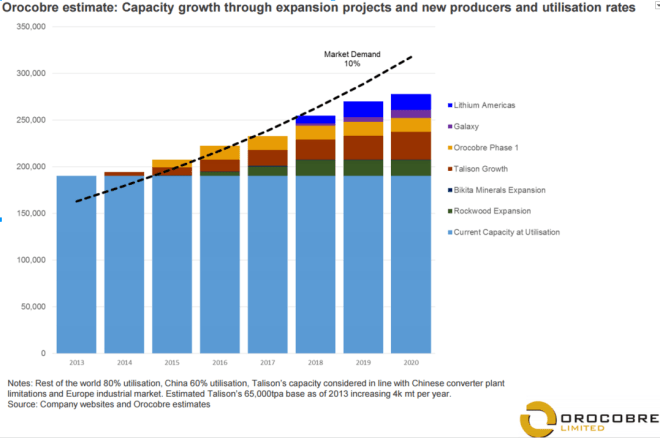
As shown in the chart above demand will most likely outstrip supply for years to come. The obvious beneficiaries of this will be current producers that either can expand production or whose prices are not fixed by contracts, as well as well funded development companies that can make it to market in the next few years.

As I said in the opening, the 2016 lithium story may be as obvious as short US housing in 2007 (although in hindsight shorting the banks was arguably the better trade), but perhaps it is more aligned with long US shale in 2010. Simply put, the economics of a previously KNOWN resource changed virtually over night and the rest is history. As a matter of fact at today’s lithium prices, it seems almost every major development project in Argentina and Chile is not only viable but insanely profitable.

The obvious result is increased production. A lot of it. I haven’t run the numbers yet on all the potential finds and what that added supply would do to the market yet, but there will be a huge surge eventually, which is another reason why I like to compare the current lithium rush to US shale. However unlike shale, the lag time between when a project is planned and when it produces are years apart. Which is why I believe there is AT THE VERY LEAST FOUR YEARS before supply catches up with demand. I expect it to be much longer than that especially considering demand for lithium is growing much faster than demand for crude did, +10% for lithium vs 1.5% (crude).

But it’s not just Argentina and Chile that are experiencing a “white gasoline” rush, the US which which has a history of resource rushes dating back to the country’s birth has made sure that lithium is no different. There are at least a dozen exploration companies some of which started off prospecting for gold and silver have now pivoted to lithium.  Nevada is now in the midst of a 1849 style gold rush. Perhaps if Las Vegas ever gets a NFL team it will be named the 16er’s, or the Tesla’s or even better the Musks. I’ll let you picture the last one’s mascot.

The point is, speculation is exploding, and some companies in Nevada such as Pure Energy Metals have already made finds around the existing Silver Peak project as well signed deals with Tesla for future production/sales agreement. Personally, from the initial estimates, the find may not be up to snuff, or at least the initial economic estimates even at today’s prices will get revised down considerably. But that’s besides the point. Companies are finding lithium in the ground right now. Pure Energy Metals may have been the first but they certainly won’t be the last.

The lithium rush isn’t confined to these three locations, I’ve found interesting projects in Mexico and western Australia, and there will continue to be more as the price of lithium remains way above cost of production even for the more expensive and inefficient producers. This will be a race to market, and whoever gets their first will most likely be a winner (at least in the short term).

Now I’ve spent this whole post talking up the greatness that is the lithium story, but before I end, I’d like to discuss a few of the bear cases for lithium. I think the first and most obvious which is the double barreled shot gun held by an ailing grandmother with Parkinson’s that stares all macro investors in the face when they wake up every morning is a Chinese hard landing. If that happens, being long lithium will be the least of your worries, and even then the world will re-calibrate and we will most likely continue move towards a green tech world. I’d hope by this point you have a trade for that scenario.

Moving on, for me, the biggest fear is the jurisdictions with the best resources, Chile and Argentina. Now I want to believe Argentina is going to behave over the next 4-5 years (my time horizon). They just had a triple oversubscribed bond offering which means the investment community has faith (or they really are just that yield starved). The new government seems on the surface quite competent and has worked hard to shed itself of the Kirchner regime’s stench. Many of the export taxes have been removed making lithium mining even more profitable. But perhaps once the government sees how wildly profitable these companies are, it may swoop in and take a bigger cut, and a bigger cut, and a bigger cut.

After all, we are players in a game with rules that constantly change, and no where has that been more apparent than in the resource space. I believe the same may hold for Chile, a country that has for a while placed strict licensing on lithium extraction. Permits have been hard to get but I expect that to change as the potential revenues become apparent.

Lastly, and without a bit of irony, I find my investment strategy somewhat dependent on Elon Musk and Tesla’s ability to deliver on its promises. After years of watching a company that sold 1/20th the cars of GM rise to half its value, and wishing it would only go higher so I could short it I now find myself wishing its success. Make no mistakes, Tesla has set a very high bar for itself that I still do not believe it will be able to reach.

However, I do not see this as a binary outcome. The demand for the model 3 is undeniable. My own brother wants one (Tr8r!). I am confident in Tesla’s ability to sell a lot of cars but perhaps not as much as the 500,000 it projects. However, it’s important to note that Tesla already has roughly 4x as many pre-orders for its model 3 than its total production of cars to date. That is an impressive stat to say the least, and although they will probably not hit the 500,000 cars per year by 2020 mark, their impact on the demand for lithium and the EV market will be undeniable.

Now I haven’t lived long enough on this earth to have the wisdom and experience that is needed to truly excel in this business but right now it feels like the wheels of fate have aligned for this brief moment of time to tell us something, except this time it appears to be screaming “LITHIUM!”


DISCLAIMER: This blog is the diary of a twenty something millennial who has never stepped foot inside a wall street bank. He has not taken an economic or business course since high school (which he is immensely proud of) and has been long gold since 2012 (which he is not so proud of). In short his opinions and experiences make him uniquely unqualified to give advice. This blog post is NOT advice to buy or sell securities. He may have positions in the aforementioned trades/securities. He may change his opinion the instant the post is published. In short, this blog post is pure fiction based loosely in the reality of the ever shifting narrative of the markets. These posts are meant for enjoyment and self reflection and nothing else. So ENJOY and REFLECT!


Lithium: Late To The Party But It’s Only Just Begun

“Beijing mandates a fleet fuel efficiency standard of 5 liters per 100 kilometers – about 47 mpg – that all automakers must achieve by 2020.”

“In 2025, we don’t expect to be able to sell conventional internal-combustion engines [China], meaning we will be selling mostly hybrids including plug-in types” ~Keiji Ohtsu, Honda’s chief technology strategy officer

“In order to produce a half million cars per year…we would basically need to absorb the entire world’s lithium-ion production.” ~Elon Musk

uyuni1-peteuniverse

Between Elon Musk promising to consume the world’s current production of lithium ion batteries and China pretty much outlawing internal combustion engines by the year 2020 lithium demand is set to take off. Just last year Chinese sales of Electric Vehicles (EVs) increased 223% and a 4 fold increase from 2014.

Not surprising this has led to an absolute parabolic increase in the price of lithium in China as shown in the chart below.

Yeah… That’s insane. China is known to get what it wants and countries around the globe have been more than willing to accommodate their demand. Currently there are just four companies that account for the majority of lithium production which are:  Sociedad Quimica y Minera (SQM), FMC Corp (FMC), Talison Lithium Ltd. Thus the additional of production needed to meet demand will have to come from mines/properties that do not yet exist. This opens up a huge opportunity for amazing returns in this space.

Looking at the chart above, it doesn’t take a genius to know that 2/5 of those countries will not be invest-able for an American investor. Bolivia is not a mining/resource friendly country to outsiders and over the last decade has nationalized various industries as well as passed a 2014 law that prevents 35% of the country’s miners from working for private firms. Not to mention, Bolivian reserves are located in a moist area which slows the dehydration process as well as a very high Mg/Li ratio which further drives the cost of extraction hgiher. China is not an easy nor transparent country that I like to invest in.

Which leaves Chile, Argentina, and the US. The US has one major deposit, Clayton Valley, in Nevada and an unproven one in Utah. For now I’ll focus on the Clayton Valley where speculative companies have acquired rights to the land around it, hoping to stirke it rich. To my knowledge so far, one company, Pure Energy Minerals, has found a relatively low grade 800,000 tons of reserves in the surrounding area. Which is nothing to scoff at, however it pales in comparison to the untapped resources down in Argentina and Chile.

And that is exactly where I’m focusing my attention. On small exploration companies with good claims and if they also happen to be speculating around Clayton Valley as well then that’s a bonus. I also am interested in SQM, the Chilean company who as of now has 22% of its revenues coming from lithium, which is small but they’ve already partnered with Western Lithium to help them develop their project and we may come to expect a lot more of that as they have the technical know how and local resources to get these jobs done.

Now it’s not all sunshine and roses. There are road bumps and Argentina still doesn’t have the most prestigious record on the earth. Also with rising Lithium prices, and a historically greedy government, Argentina may swoop in and tax more of a company’s profits.

China’s economy is slowing down and although betting against them hasn’t been successful that doesn’t mean the future will be more of the same. And lastly, it’s an understatement to say that Elon Musk and Tesla have lofty expectations. Currently, Tesla makes less than 50,000 cars/year. Expecting to produce and sell 500,000 cars/year within 4 years seems quite ambitious to say the least. I know he’s building a gigafactory and wall street toured it and loved it but Tesla still has a long way to go.

Lastly there’s the threat of future innovation. With high prices comes high incentive for innovation. Although lithium ion batteries have dominated the space for more than a decade, it’d be foolish to think that dominance will last forever, especially in a world of big data, AI, and high incentives.


DISCLAIMER: This blog is the diary of a twenty something millennial who has never stepped foot inside a wall street bank. He has not taken an economic or business course since high school (which he is immensely proud of) and has been long gold since 2012 (which he is not so proud of). In short his opinions and experiences make him uniquely unqualified to give advice. This blog post is NOT advice to buy or sell securities. He may have positions in the aforementioned trades/securities. He may change his opinion the instant the post is published. In short, this blog post is pure fiction based loosely in the reality of the ever shifting narrative of the markets. These posts are meant for enjoyment and self reflection and nothing else. So ENJOY and REFLECT!

Market Ramblings: 03/03/2016

“I regard it as unwise to continue a normalization strategy in an environment of declining market-based inflation expectations” ~St Louis Fed President Bullard

After a lukewarm January jobs number, February came through in a big way with 240,000 non-farm payroll jobs added. CPI and PCE are up in February. The labor force participation rate is up as well. The Philips-curve economists at the Fed now have all the data they need to JUSTIFY a rate hike in March.

Even the dollar is down against gold and the Yen. The dollar has risen against the Euro as the market tries to front run Mario Draghi’s bazooka.  As I stated in my previous post, I think Draghi will disappoint the markets, and the Euro could rally against the dollar, giving the Fed even more reasons to hike interest rates. In short, St. Louis Fed President Bullard is going to look like an idiot come March… unless a certain nation devalues its currency.

A Fed rate hike in March would accelerate the global trends that are leading to a global recession. The dollar would strengthen, commodity prices would continue to fall, dollar liquidity around the globe would shrink, capital flight out of emerging markets would accelerate and those deflationary pressures would come home to roost in the US.

It’s hard to imagine a worse environment for economic growth. And in a growth slowing environment, the economies with the largest and most unsustainable debt bubbles are the most vulnerable.

Of course I’m talking about China here. Arguably no country is more susceptible to the negative impacts of a strong dollar, and also no country is in a position to stop a Fed rate hike, which places China and the PBoC in an unique position.

If the PBoC was to devalue the Yuan like it did last August causing risk assets around the globe to sell off dramatically and depress commodity prices even further. Another Yuan devaluation would be the PBoC’s way of beating the Fed to the deflationary punch, but in this case, instead of the Yuan rising with the dollar, it would fall, easing the deflationary pressures in China.


The alternative is that the PBoC does nothing, the Fed hikes, and the Yuan rises with the dollar putting further deflationary pressures on China’s massive credit bubbles. As the bubbles burst, capital flight would accelerate, weakening the Yuan even further. The Fed rate hike would thus lead to an eventual weakening of the Yuan.

In both cases, China is screwed. There are no easy way outs and the Yuan is headed lower whether the PBoC wants it to or not. Therefore, weakening the Yuan to prevent a Fed rate hike would not only be a step in the right direction but also prevent the Fed from simultaneously draining further liquidity from China’s economy. I’m not saying that the PBoC will devalue the Yuan to prevent a Fed rate hike, I’m merely arguing that it is in their best interest to do so.

March Madness: Central Banking Style

og-ad984_madnes_8h_20150313174026

Right now, there’s a massive disconnect, between what the market thinks the central bankers can do and what they actually can do. What I believe the scariest thing to be, is the world’s reliance on Central Bankers increasingly ineffective toolkit at a time when political will to use these tools is waning. People like to think central banks are independent, but in today’s world, we know that is simply not true.

Political will for additional QE seems to be waning. The Fed cannot go to QE in an election year. The ECB, constrained by its German handlers cannot meaningfully expand its QE. The BoJ cannot accelerate its QE program or the BoJ will own all the JGBs in a few years.

Despite all their negative effects, NIRP has become all the main weapon in the central bankers’ arsenals. NIRP is easy to do, just change one number, and viola a weaker currency, or so the BoJ thought.

Before I go on, I’d like to preface the rest of this article with my belief that the central banks are fighting a losing battle against deflation. They can push on a string, and steal growth from else where, but in the end, no real growth is created. And due to the massive credit bubbles central bankers have shepherded over the past few decades, global growth hasn’t been this scarce since the 1930’s. In essence, central bankers are like rats fighting over the few remaining scraps their policies haven’t completely poisoned. The deflationary forces may seem to disappear for a while, but always return stronger and more powerful than before. With the central bankers running low on ammo, this is not a good time to be long central banking competency.

As it stands currently, the ECB and the BoJ cannot significantly devalue their currencies through another major QE program.There simply aren’t enough government bonds for them to buy, and even if there were, the transmission effect of lower government bond yields has almost zero impact on the real economy.

The fact, of the matter is that banks in the EU are not lending because there is no incentive for them to do so. Saddled with NPLs, taxed with NIRP, under-capitalized and forced to hold low yielding government debt the EU’s banks are struggling as is.

NIRP is proving to be worse for banks than a flat or inverted yield curve. The banks have been too afraid to pass the tax on to their depositors for fear that people will take their money out and the banks will become insolvent if they aren’t already.

Interest rates are too low for the banks to make any money on a loan. Although lots of people may be happy to borrow at 1% for 10 years, no bank in their right mind would agree to lend under such terms, which is why we see no credit growth in the European economy. With no credit growth, the economy stalls then crashes.

Any additional QE from the ECB would be a sign that the ECB is desperate to get the Euro down at all costs, even if it has almost no positive effect on credit growth. I don’t think this is as likely as a big rate cut, but I wouldn’t be surprised to see Draghi expand QE by another $20B a month, but that would only confirm my fears, that the political capital is not there for Draghi to do “whatever it takes”.  In that case, Draghi could disappoint the markets and the Euro would rally as EU equities tumble.

For me, and for the world, Draghi needs to monetize private debt off EU bank balance sheets to the tune of tens of billions a month. Much like the Fed’s MBS program, the ECB needs to clear the bad debt off Europe’s banks if the economy is to move forward. However, even a move this extreme would have little effect on credit growth in the economy. Europe’s banks are in such bad shape that it would take years and trillions of euros to solve any of their problems in a meaningful manner. At the very least, such a move could ignite a huge rally in European bank equities and probably lead to a temporary rally around the world.

The odds of the ECB monetizing private debt at the March meeting are under 5%. I just don’t see the political will to do such a thing. Europe’s banks may be on the brink, but central banks are reactionary and will only act after the crisis has come.

Hilariously with Europe’s banks on the brink, the ECB is expected to cut rates by 20bps. The damage that this will cause to Europe’s fragile banks cannot be understated. Another cut for me would signal that either the ECB doesn’t understand how negative rates work, or the ECB doesn’t realize how bad of shape the banks are in, or the ECB is out of ammo and needs to devalue the currency at any cost. Personally I think its the last one. And hey, maybe if Europe’s banks do crash, then the ECB will have the political capital to buy private debt, which is what it wants/believes it needs to do in the first place.


If it isn’t exceedingly obvious that the ECB is either is incompetent or trapped then you aren’t paying attention. I think the market is slowing coming around to this conclusion. We’ve seen hints of their disbelief. When the BoJ cuts rates and the Yen rallies. Or when the Fed says it’s going to hike yet FF futures crash. The markets are growing increasingly wary of central bankers.

In the US we’ve seen the stock market rebound, inflation and growth rebound as unemployment continues to fall, effectively giving the Fed all the ammo it needs to raise rates in March. Such a move would further drain precious dollar liquidity from a global economy that has never needed it more. In the wake of a Fed rate hike, the dollar should rise, emerging markets should succumb to more capital flows, and China should feel additional strain, none of these things are beneficial to the long term stability of the global economy, and yet I see no reason why the Fed won’t hike in March, further confusing the markets.


Timing is everything, and it’s hard to predict a loss of confidence in an institution that has done nothing to deserve said confidence in the first place. The best one can do is look at the signs and stay vigilant. At the very least, by the end of the month, after the central banks of the US, EU, Canada, England, Japan and Australia meet, we will have a much clearer picture of where the central banking competency narrative stands.


Binary Thoughts: Man Imitates Machine

image5

Maybe it’s ironic or maybe it’s just plain logical that as computers invaded our lives, they also invaded our thoughts. Human brains are incredibly complex systems, capable of producing an unlimited array of emotions, thoughts and opinions across complex fluid spectra. Computers on the other hand use the cold logic of mathematics to process and relay information. To a computer a problem is broken down into ones and zeros, for humanity that’s increasingly becoming the case.

Today we live in a world of extremes. All or nothing. My way or the highway. The world is deeply divided on virtually every issue. But why?

Extreme monetary and unresponsive fiscal policy have led humanity into an unknown territory. Each side’s mistakes only amplified the other’s, building on each other and taking us to a radical new place not seen in living memory. In essence, we are off the edge of the map, but if history is our guide we know things only get worse from here before they get better.

And as we head off into the unknown, people are growing with fear uncertainty and most importantly desperation. There’s a palpable tension in the air. One wrong step, and we could fall off the edge of the world. As Ray Dalio puts it “risk is asymmetric to the downside”.

The stakes are so high and the margins of error are so thin that only one side in an argument can be correct, which leads a piling up on opposite sides of the fence with nobody in the middle. No side is willing to compromise. Hence the binary thinking.

The danger of the trend towards this binary thinking is incredibly dangerous and once again echoes the darkest times in history. If we give in to this belief that there is only one way out then we are doomed, because to be perfectly honest, there is no “good” option. There are varying degrees of bad.

Humanity has failed to deliver on its promises over the last 40+ years. We don’t have universal “free” healthcare, we don’t have funded pensions and we don’t even have flying cars. The time to pay for our mistakes is not in some distant future, that time is now. We have pushed everything beyond their normal limits and the bands are so stretched that when they snap back things will break. Things that people depended on. Things that people based their whole life around. Things that people cannot live with out.

Once again, irony plays a role, as the very things people cannot live without were based on a very unique society living in the aftermath of the very road map that we are closely following today.

Unbeknownst to many WWII, which is perhaps the most powerful dislocation since the black plague wiped out 1/3 of Europe’s population in the 14th century, still affects us to this day. Tens of millions of people were killed. Entire nations leveled to nothing. And when it  was over the US held half the wealth of the entire world.

The society that grew out of the ashes of WWII was built on the a once in a 600 year dislocation. So it’s no surprise that the dollar reserve currency, social programs, and demographics, the very pillars of our post WWII society, have become obstacles standing in the way of future growth and prosperity.

These pillars are outdated, and have been for decades as the increasing bipartisan nature of politics paralyzed democratic governments. This inaction has led to the steady deterioration of society. Politicians have noticed this deterioration, which is why the only policies they can agree on, is to give themselves even more power so that when the social fabric breaks, they can step in and take control. Think about that for a second.

So the rise of extreme right and left wing parties shouldn’t be a surprise. The citizens have been so marginalized during this whole cycle, that they are willing to support almost any change without any thought to the cost.

When it comes to volatility, politics is giving the financial markets a run for its money.  Like a phoenix reborn new and improved, the death of one extreme party will give rise to its polar opposite. Like people on a boat, running from one side to the other hoping to find safety on the other sides. As the pro EU movements fail across Europe we’ll see a rise of anti-EU ones, and most likely, the break up of the EU as we know it.

Americans should be more concerned with who they elect for president, I’m not sure any of our current candidates are capable of such a tough job, but then again they do say that time makes the man, I can only hope that is true. And remember, if you are all in one camp remember the following:

only-a-sith-deals-in-absolutes


China: The $10T Question

1198809299267

I’ve noticed a trend in my recent articles, where I start on one topic and usually end up talking about three other things instead. Using the it’s not me, it’s you argument, I’m going to blame this on the global economy for being so damn fragile and interconnected. With that said let’s get on with not answering the $10T question.

Anyone who saw The Big Short or were contrarian enough to have actually read the book, will know that the men who lead the charge against the US housing bubble opened themselves up to a vast swath of criticism and ridicule.

So it’s not surprising that the mainstream, other investors and least surprisingly of all China are all criticizing and ridiculing the likes of Kyle Bass, George Soros and Mark Hart for their positions against the Yuan and indirectly, China’s economy.

PBOC governor Zhou came out with a very solid interview the other day. It was so good, that the market actually believed him, and maybe it was to be expected. The PBOC hasn’t given the market enough to doubt its omnipotence.

The biggest bubble of them all is the one in central banking competence. Maybe I gave the market too much credit (the CCP certainly does (get it?)), or maybe Zhou’s speech really was that good, perhaps we are looking out the makings of a Draghi 2.0.

Unfortunately, Draghi has shown to be quite limited. The Euro is strengthening, the economy is imploding, and the stock market is crashing, all whilst embarking on QE and negative interest rates with a threat of future cuts.

But back to Zhou, what did the market expect him to say? “Please don’t speculate”? He pretty much told the world in a very calm and commanding manner that #everythingisawesome.

And if #everythingisawesome, and China’s banking sector is fine, then capital will stop fleeing the country in record amounts once people realize that everything going on outside of China is actually relatively even worse.

We live in relative world, and maybe China stands up longer than Europe or Japan do, but if their struggling, what does that mean for the US?  The US’s recent struggles have been well documented and suggests an even further slow down, which will be an even further drag on global dollar liquidity. Given the shrinking dollar liquidity that will result from a slowing US economy coupled with a tightening of Fed monetary policy, EMs will be under even more pressure to tighten their economies to prevent even further capital flight.

Which then comes back to China and their ridiculous credit bubble that seems to have taken the game to another level as of late. How long will that last? And that’s the $10T question isn’t it. Because a bet against the Yuan is essentially an attempt at picking the top in a multi decade bubble. So if Mark Hart, Kyle Bass, and George Soros are met with resistance, some of it must be attributed to the belief that “who are you to be able to call such a peak”?

Many have come and gone before claiming China’s over-investment is unsustainable. Many have noticed China’s excess and ghost cities way back in the early 2000’s. And Many have been wrong. It’s 2016 and China is still churning out record amounts of credit.

This isn’t the first time Kyle Bass has tried to call the top in a multi decade trend when he shorted JGBs back in 2012. He looked at the problem logically and saw a confluence of negative factors that no central planner could solve. Japan at the time had and in most of these cases still has the following: declining demographics, declining or stagnant GDP growth, rising debt growth, zero inflation, and a trade deficit due to Fukushima.

The fact that Japan has limped on for 4 years since then is sign of just how hard it can be to call the turning points in multi-decade trends. Kyle’s short JGB thesis was built around the idea that Abe would be able to push inflation to 2%. As the world, Yen carry traders and Kyle Bass have now learned that central bankers actually cannot get inflation up with their current set of tools.

The idea was based on the belief that lower interest rates would spur people to lend more money to get a better return. Theoretically as the risk free rate reached zero, there should be no incentive to hold it. But we live in relative world. And at this point in the game, people would rather pay for safety ie. negative rates, or sit on the sidelines rather than go any further out on the risk curve. In essence, investors for the time being, are tapped out.

And this is why Kyle Bass was wrong on Japan. Central banks cannot create inflation with QE or NIRP. Because what are those tools doing? Front loading demand. And when you front load demand, you get a quick spark on inflation but nothing that is sustainable, because once you get to the future and realize that there’s no demand there, you get deflation. Well we are living in that future, so what do we do now? Continue to borrow demand from even further out?

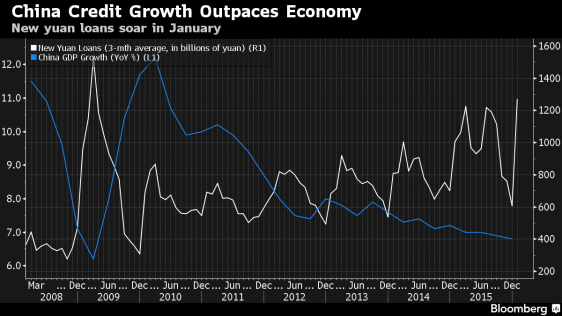
We are witnessing the limits of the current monetary policy tools. As debt levels rise, it takes even more debt to generate growth. Which is why we come back to China, where judging by the chart below, no nation understands this better.

china20vs20us20bank20assets20-20total20and20change

Over the five years immediately following the GFC, China’s banking system went from $9T to $24T, an average of $3T a year. In the last 2.5 years, China has added over $12T to the banking system bringing it to $36T, an average of $4.8T a year,
1x-1

If January is any indication, China is set to continue with its massive credit growth. For the month, Chinese banks generated a whopping $500B in new loans. To put that to scale, China’s banking sector added more debt than the GDP of the entire country of Norway.china-jan-new-debt-480x299
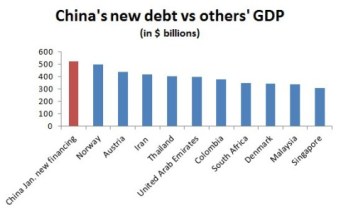
China has known for a long time that in order to keep the game going they have to issue exponentially greater amounts of debt to keep the economy afloat, which to be quite honest may be possible for a little while longer. It is a little difficult to say when. Akin to Japan, this has been going on for decades. To call a top after 20 years is quite difficult as Kyle Bass well knows.

However, that doesn’t mean there aren’t visible catalysts out there. The most obvious is the capital flight. China has lost  $1T of FX reserves at an accelerating rate. But with $3.1T remaining, China does have some time before it burns through all those reserves.

Now the most common argument is that $1T of those reserves are in illiquid assets, which if you can believe China is not true. If those FX reserves were illiquid they would not be able to qualify as FX reserves according to the rules of the IMF. So if we assume that China has a $4T in funds left, then they can maintain capital outflows for at the very least a year, if not two.

Two years is probably more than the EU has before their next banking crisis. Right now Italy like China is having its own NPL problems. The Italian government would love to clear that debt off the balance sheets through a devaluation of the Euro and other such measures but they don’t control the ECB. Germany runs the show.

It’s not just Italy that’s having trouble, the whole EU is doing quite awful. Negative rates and poor regulations have strangled their banking sector. European banks are getting squeezed at the short end with negative rates and have to make up for it on the long end with higher interest rates. So actually lending in the EU is declining even though rates are falling. In essence, NIRP may depreciate your currency but at the cost of your banking system.

Japan is also learning this lesson. Not to be out done, the BoJ nuked themselves and have been paying the price. However, the Yen is a “safe haven” asset and when the BoJ nuked the Japanese banks they signaled a crisis which forced a lot of capital back into the Yen which strengthened as a result. So NIRP in Japan strengthened the Yen and hurt the already vulnerable banking system.

At the moment, neither the BoJ or the ECB is willing to increase their current QE programs and are only threatening further NIRP! It’s pure insanity but their banking sectors are going to implode as a result of this misguided policy.

So to say, China, who is actively working to prop up it’s banking system, will crash before Japan or the EU, who seem to be actively working to destroy their banking systems, is a hard call to make.

I think it is more important to focus on the forces at work and what they mean for other asset classes. In a sense, I’m attempting to be agnostic when it comes to time, and just benefit by the overall trend rather than a specific move. The overall trend here is lower interest rates, more debt, more deflation, more instability, more volatility, and less growth. The last one to me is key. The whole world is obsessed with GDP growth, so whether you think it’s a good statistic or not you have to follow it, and right now, growth especially coming out of Asia is falling dramatically. China, Singapore, Korea, Japan all reporting negative trade growth over the past quarter.

So I’m not saying that China won’t devalue it’s currency, a month ago I actually wrote an article comparing 2016 Yuan to US housing in 2008, but it’s important to realize that it is not the only possibility and there are perhaps less risky ways to make a smaller but strong return off asset classes that benefit from the same trends affecting China and the rest of the world.

Once again, I’ll bring up that the Chinese economy is incredibly fragile but there are still active participants doing everything they can to prop up the status quo, which makes it harder to predict as opposed to the Fed, ECB, and BoJ who are almost standing idly by as their respective economies burn to the ground. Remember, as long as the central bankers are involved, the global economy remains a confidence game, and the current capital flight certainly doesn’t bode well for the Chinese people’s confidence in the PBOC and CCP’s ability to manage it.



2016: Major Turning Point

turning_point_sign_compressed

Mainstream thought suffers from the illogical belief that humanity has some how tamed economic cycles. The ancient Greeks had a word for this belief that humans are masters of their own fate – hubris.

This isn’t the first time the mainstream has fallen victim to this belief and it won’t be the last. Like all things, mainstream thought is affected by the very cycles it refuses to acknowledge.

The congressional budget office, is currently predicting +1.5% annual GDP growth for the next 4 years and +2.0% annual GDP growth for the following six years. In essence, the CBO thinks the US will go the next 10 years without hitting a recession. That 10 year stretch would be the longest in history without a recession, throw in the current 7 year run, and you get a ridiculous prediction of 17 years without a US recession!  This kind of thinking isn’t just stupid, it’s dangerous.

The same mainstream group think that has failed to understand the rise of Trump and Sanders will be unprepared for what comes next. It doesn’t matter whether you agree with their platforms or not but that you understand why their platforms are gaining popularity.

Back in 2014,  I detailed how the world’s poor leadership would only increase the desperation of the global population which would then lead to the election of radical leaders. This is based on the simple but logical belief that an unhappy and desperate population would be willing to do almost anything to change the status quo.

If you open your eyes you can see these tectonic shifts happening all around you. But in order to do so, you have to question everything, and come to the conclusions on your own.

For example, for the first time in decades college students in America prefer socialism to “capitalism”.  Ironically, the same people that don’t trust the current system still fall victim to its beliefs. The truth is, young college students don’t hate capitalism, they hate the current system, which mainstream thought tells them is capitalism. And this is exactly why these young college students come out in droves for Bernie Sanders for he is promising them a new system, and they “hope” that it will be better than their current one.

The same argument can be made for Trump’s supporters and the tea party before them. The common man on both sides of the aisle is greatly displeased with the way things are run and wants radical change, at any cost, almost irregardless of the platform they are voting for.

So here we find ourselves, one giant interconnected society unaware that we are on the verge a major turning point. The ground beneath our feet has turned, and the permanently high plateau of constant growth is quickly eroding. Unfortunately people continue to underestimate the speed at which plateaus change into cliffs.

Arguments can be made that a previous year was a turning point in this post crisis era, but in 2016 I believe the linear mainstream thought will crash head first into the reality of cycles.

And so far that’s exactly what has happened. The cracks in the world economies can no longer be ignored or kicked down the road by any one central bank.

The immediate response to this situation has been a one of rejection and denial. Obama would qualify this article as a work of pure fiction. Central banks have fought and clawed and screamed at the top of their lungs that the recent market moves are pure madness.

And this sort of behavior is to be expected. I remember when I was a young boy and discovered Hogwarts wasn’t real. That was a tough time, indeed. I had long dreamed of being chosen to play quidditch for Hufflepuff, duel against dark witches and wizards, and even chase Dragons.

But whether it is a life or an idea, death is difficult for the mind to reconcile. So in some ways I empathize with the current mainstream thought, but at the same time admit that unicorns and something out of nothing alchemy remain firmly trapped in the fictional worlds of Harry Potter.


Panic Has Entered a Bull market

wall_street_bubbles_-_always_the_same_-_keppler_1901

Panic has entered a bull market, and in a bull market, you want to buy early and reap the rewards. It is no longer good enough to be standing near the exits. It’s time to get out of the theater. Go outside and sell people some safety. The show is over…

And central bankers know it.

The market is under this false narrative that the market is not tight enough to force Yellen to ease. Read the excerpt from her statement yesterday and tell me she doesn’t believe financial conditions warrant further easing.

As is always the case, the economic outlook is uncertain. Foreign economic developments, in particular, pose risks to U.S. economic growth. Most notably, although recent economic indicators do not suggest a sharp slowdown in Chinese growth, declines in the foreign exchange value of the renminbi have intensified uncertainty about China’s exchange rate policy and the prospects for its economy. This uncertainty led to increased volatility in global financial markets and, against the background of persistent weakness abroad, exacerbated concerns about the outlook for global growth. These growth concerns, along with strong supply conditions and high inventories, contributed to the recent fall in the prices of oil and other commodities. In turn,low commodity prices could trigger financial stresses in commodity-exporting economies, particularly in vulnerable emerging market economies, and for commodity-producing firms in many countries. Should any of these downside risks materialize, foreign activity and demand for U.S. exports could weaken and financial market conditions could tighten further.” ~ Janet Yellen

As head of the Federal Reserve, Janet Yellen has immense and diverse powers that most people aren’t factoring into their interpretations of her speeches. If Yellen were to tell the Chinese that their banking system is insolvent and their economy is going to collapse, what do you think would happen?  There would be a bank run, China’s economy would collapse, and the CCP would blame the US and declare Yellen’s speech an act of economic warfare.

The truth doesn’t just hurt, it brings the world’s second largest economy to its knees. And it could do that to almost any other major economy as well. So if you were expecting Yellen to spell out in plain English that the world economy is on the verge of a depression, then I’d take the top out of your pocket and watch it spin for eternity. Come back to reality where what should happen and what actually happens are two very different things. Yellen speaks in what is commonly known as Fed speak. And in Fed speak, Yellen is telling you that she knows the world is in serious trouble.

To make matters worse, she knows they are out of ammo. So what is the Fed doing? They are out making bullets for the next battle.

Unfortunately, the Fed is learning hard way that you can’t make something for nothing. Those bullets have a cost. Each rate hike sucks the global economy of dollar liquidity that it is so desperately hooked on. In essence, Janet Yellen is destabilizing the global economy so that the Fed has more tools to help the US. If that doesn’t tell you every central banker for him or herself, than I don’t know what does.

If the Fed could ease they would, but a 25 basis point cut will not help the economy and only signal to the world that the Fed doesn’t know what it’s doing. Now I’m not saying they won’t cut, but I am saying that any rate cut won’t have the same effect that the market hopes it will.

Even a negative interest rate cut would have profound implications that I don’t think people are taking into account. We’ve seen what gold does in a falling rate and dollar environment. If the Fed goes NIRP, gold will shoot through the roof and the Fed will lose credibility that way. So if the Fed does cut, the market may be happy at first, but that elation will turn to panic when the market realizes the implications of the Fed reversing course.

That leaves QE, which to me isn’t an option in an election year. The Fed knows that QE has very little effectiveness but even less without increased fiscal spending in tandem. In an election year, in the final year of his reign, the odds of Obama passing a huge fiscal spending bill are slim to none. So the Fed if they choose to launch QE will have to be without the aid of fiscal policy, knowing full well that QE4 will not be effective. Which leads me to believe that they will not openly launch QE4 this year in the absence of a serious stock market crash >35% and a US recession.

The Fed isn’t the only one under the gun, for now I’ll just talk about the BoJ, who have proved quite inept and keeping their carry traders alive. The BoJ cut rates to negative and the Yen strengthened over 7% in 7 trading days. USDJPY at the time of this article is trading with 111 handle. The carry traders are getting killed right now, and this trade will only get worse as it unwinds. The BoJ may be forced to print Yen and sell them on the spot market to devalue the currency and delay the inevitable.

I doubt the BoJ will be going any further negative especially considering the negative rate cut was a vote that was barely passed at 5-4. Once again though, I could be wrong, but even if I am, I think at this stage, any further rate cuts only further destabilize the Japanese banks and its economy.

If you hadn’t noticed yet, central banks are impotent, and the market is very slowly discovering that fact. When the market does, all hell will break lose. Take advantage of its blindness.


Would You Like to Know More: Yellen forced to make her own bullets

It seems like forever ago, when central bankers were at the height of their powers. Back when Draghi could save the EU from the depths of destruction with a single phrase and Kuroda could devalue the Yen at will. But alas, those days are over.

The truth is, since 2011, the primary force in the world has been deflation not inflation. The central banks of the world were fighting not just a losing battle but a losing war of attrition. In essence, they were doomed to fail, and now that the BoJ and the ECB are out of ammo, the deflationary forces will crash their respective economies.

To make matters worse, people actually believed the BoJ and the ECB would actually win. Which is why there are such large short positions in the Euro and Yen. But now these short positions are blowing up as the currencies rally on top of a crashing economy.

Over the coming months the word “contained” will be thrown around a lot. Despite what central bankers would have you believe, nothing is contained. The markets are all connected and levered up more times than anyone can possibly conceive. Never in history have our markets been so interconnected and at the same time so fragile.

It’s why a sell off in US equities can lead to a fall in the dollar, a rise in the yen and a drop in the Nikkei, which leads to further a rise in the Yen and another drop in US equities. There are deadly feedback loops in place to guarantee the shock waves are NOT contained.


I’m not saying the game is over just yet, but we are moving to the final stage. Draghi and Kuroda are not likely to go down without a fight. Which means, more NIRP and maybe threats of more QE, but the world doesn’t need Yen or Euros. It needs dollars. Any of the BoJ’s or ECB’s attempts to stabilize their economies without the Fed’s help is a moot point.

Which brings me to Janet Yellen. Before the Fed’s last meeting in January, I discussed the market’s dire need for more dollar liquidity (QE4), but the Fed didn’t listen. They kept their hawkish bias and betrayed their ignorance all at once.

For whatever reason, the Fed wants to keep tightening. Now I will bring up the fact that a strong dollar is good for  Europe and Japan, our two allies, and bad for China, our enemy.

Maybe it’s not that simple, but I think Yellen is missing the point that, as bad as the ECB and the BoJ need a stronger dollar, the rest of the world needs a much weaker dollar. In order to accomplish that, we’d need to see massive additional easing programs from the BoJ, ECB, and Fed simultaneously. That way, the EURO and YEN still fall or maintain their current position against the dollar at the same time the global markets are flooded with cheap dollars to artificially inflate demand.

I don’t know if that’s going to happen. I don’t think Yellen and the Fed truly understand the magnitude of the situation. And even if they wanted to launch QE4, the US government is in no shape to run a massive deficit in Obama’s last term. Politically that is a very ugly situation, which leads me to believe, barring a 50% draw down in the US stock market and or a systemic global banking system collapse we won’t see QE4 till 2017.

Which means the Fed is left with negative rates. But as some people have pointed out, negative rates may not be possible, with the addition of the reverse repo facility and the Fed’s own laws. Perhaps the Fed is aware of how little ammunition they have left and that is exactly why they are hiking.

Which leaves the Fed pretty empty on ammo for the rest of the year as well. The only way they get more ammo is to make it themselves via rate hikes. With the Euro and the Yen much stronger the Fed has the leeway to continue with its hiking cycle and build itself some more ammunition. Thus the market may get a rather rude surprise tomorrow when Yellen comes out on the hawkish side.